
Karma knowledge archive
Why Founders and Startups ignore compliance until it breaks them
Founder Pod recap with Pratik Vaidya on founder systems—compliance, hiring timing, delegation, culture-first decisions, and scaling without firefighting.
Original publication: 2026-01-14
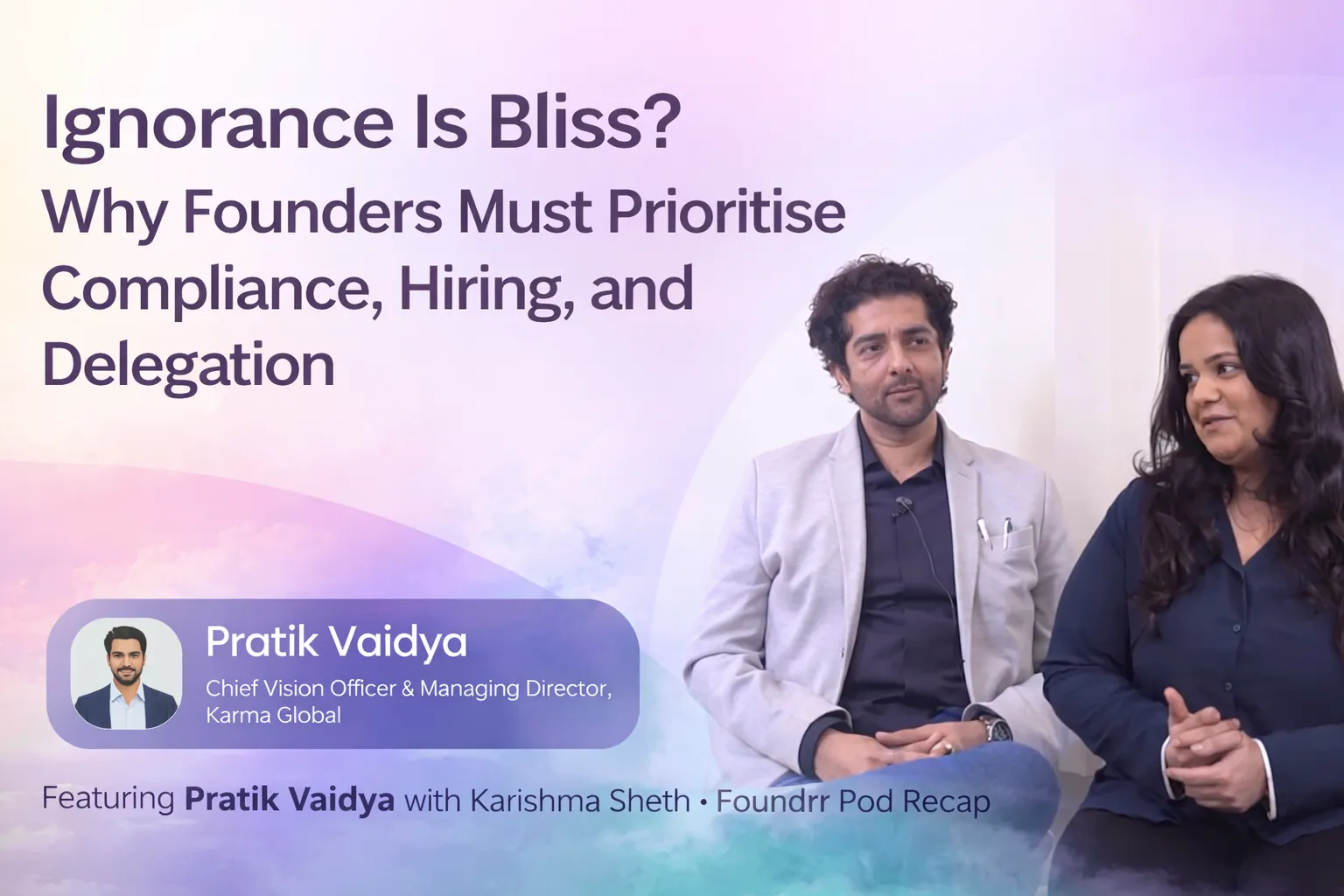
Foundrr Pod Recap • Founder Systems • Compliance • Hiring • Leadership
Ignorance Is Bliss, Or Not a Bliss?
If it is a bliss, it can also be a blindfold on the path of knowledge and compliance.
In this episode of Foundrr Pod, host Karishma Sheth speaks with Pratik Vaidya, Chief Vision Officer and Managing Director of Karma Global, about the systems that quietly shape long-term founder success—compliance, hiring, delegation, and the shift from operator to leader.
Conversation focus
Compliance in India, founder decision-making, and growth systems—without constant firefighting.
Leadership shift
From doing everything to designing blueprints, delegating execution, and measuring outcomes.
Why it matters
Early oversights compound into long-term risk, cost, reputation exposure, and operational drag.
Episode overview
A founder conversation anchored in real decisions—not theory
From “why compliance in India is uniquely complex” to “when founders should hire, slow down, or let go,” the discussion explores how organisations can scale with fewer crises, better accountability, and stronger leadership systems.
Who this episode is for
Business founders navigating growth, people, process, and responsibility—trying to build something that lasts.
Themes that repeat across the conversation
Why early compliance oversights become long-term risks.
Scaling without constant firefighting through structure and accountability.
Hiring and team design under bootstrapped constraints.
Integrity and impact over short-term predictability.
Using technology with intent—not as a shortcut.
Verbatim-style capture note
The conversation below is presented in a first-person, transcript-like flow to reflect the pace and direction of the episode, bringing forth key minutes and decision points.
Opening hook
The three questions that set the tone
Pratik Vaidya to the audience
“How to balance between structuring capital, how to balance between profits, hiring right resources…”
He shares that he had two choices: a cushy job, or building something significant for Indian businesses.
Karishma Sheth’s opening challenge
“But what about founders that are bootstrapped and cannot afford to hire multiple resources?”
A central line emerges early: ignorance may feel convenient in many areas, but in business compliance, it becomes an avoidable risk with real consequences.
Founder journey and the paradigm shift
From corporate to building for Indian businesses
Karishma’s question
“What was your journey like? You are also the founder, right?”
Pratik’s answer (paradigm shift)
He describes a transition rooted in commerce and law with a strong interest in technology—moving from corporate technology roles into transforming a traditionally-managed compliance business into a more tech-enabled model, driven by what he calls a “family calling.”
A framework he repeats: the 3 Ps
He shares a simple operating philosophy:
Passion
Choose what you truly care about.
Patience and Perseverance
Nurture it long enough to see outcomes.
Profits
An eventual outcome of the first two.
Karishma asks what his work involves today. Pratik explains it as strategy, client conversations, mentoring, and planning what comes next—seeing technology as an enabler, and AI as the new acceleration layer for speed and precision in execution.
Hiring and delegation
Start with blueprints, then hire for the cycle
Pratik’s blueprint lens
He urges founders to keep a blueprint ready before scaling headcount, anchored on two cycles:
Order to Cash (O2C)
Marketing to lead generation, sales, operations, finance, billing, and collections.
Procure to Pay (P2P)
Procurement of materials and services, vendor workflows, and payment execution.
What he advises founders to avoid
He cautions against rushing to hire without clarity, and highlights that a person can multi-task, but cannot do everything at once. The suggestion is to compartmentalise, focus roles, and expand scope only after consistent delivery.
Bootstrapped reality
He suggests structuring compensation smartly—fixed pay, variable, and where relevant, equity—while hiring for execution strength and strong communication.
Leadership marker
A true leader is presented as someone who delegates well and orchestrates execution—measuring outcomes, not busyness.
Compliance realities for founders
The overlooked first licence and the cost of “later”
What founders often miss
Pratik points to a basic, foundational compliance step that gets ignored: the Shops & Establishments registration (or the appropriate licensing route depending on the nature of business, including factory licensing where applicable). He notes that even coworking setups need compliant licensing for doing business.
The line that stays
Ignorance can be bliss in other things, but ignorance in business and compliance is a crime.
What Karma Global does (as described)
Pratik explains Karma’s service sphere across HR consulting and outsourcing, and employment law compliance—policy alignment (including POSH and HR policies), payroll accuracy, and lifecycle structures from hiring to retirement. The focus is positioned as value and outcomes, not transactional filings.
A practical takeaway for founders
The same law can apply to a 10-employee company and a 2,000-employee company. System-building early becomes a compounding advantage.
HR in the hot seat
Realistic crisis decisions and Pratik’s responses
Hot seat scenario 1
Highest revenue sales head is brilliant, but creates a hostile environment, mocks juniors, and threatens to quit if disciplined. Do you risk revenue by enforcing culture or protect the numbers?
Pratik’s answer
Culture first.
Toxicity is positioned as a long-term cost that blocks future growth, even if short-term revenue looks protected.
Hot seat scenario 2
A client’s payroll audit shows ineffective staff still on payroll due to poor tracking by a local HR vendor. Do you report immediately and risk trust, or quietly fix first?
Pratik’s answer
Report immediately, then drive corrective action.
The episode frames undisclosed audit findings as a large risk that must be surfaced with clarity and solutions.
Hot seat scenario 3
An employee in the outsourcing division is working part-time for a start-up but performing well in both roles. Do you fire them for conflict of interest, or formalise flexibility in policies?
Pratik’s answer
The distinction is communication and trust. If disclosed voluntarily and aligned to agreement, it can be considered. If done behind the organisation’s back, it becomes moonlighting and a trust breach—with a firm response suggested.
The hot seat segment reinforces a consistent stance across scenarios: clarity over convenience, culture over short-term performance optics, and transparent reporting over silent fixes that accumulate risk.
Closing note
The real takeaway: systems protect founders from future chaos
This episode connects compliance with leadership maturity. The message is not fear-based; it is future-proofing based on structure, clear decision-making, and integrity-led choices. When compliance is treated as a system (not a last-minute task), founders gain time, credibility, and focus to build what truly matters.
For compliance guidance and implementation support, write to marketing@karmamgmt.com