
Karma knowledge archive
Karnataka Labour Welfare Fund Amendment 2025 – from 50 or more employees reduced to 10 or more
Karnataka Labour Welfare Fund Amendment 2025 lowers applicability from 50 to 10 employees. Learn impact, contributions, timelines, and compliance steps.
Original publication: 2026-01-13
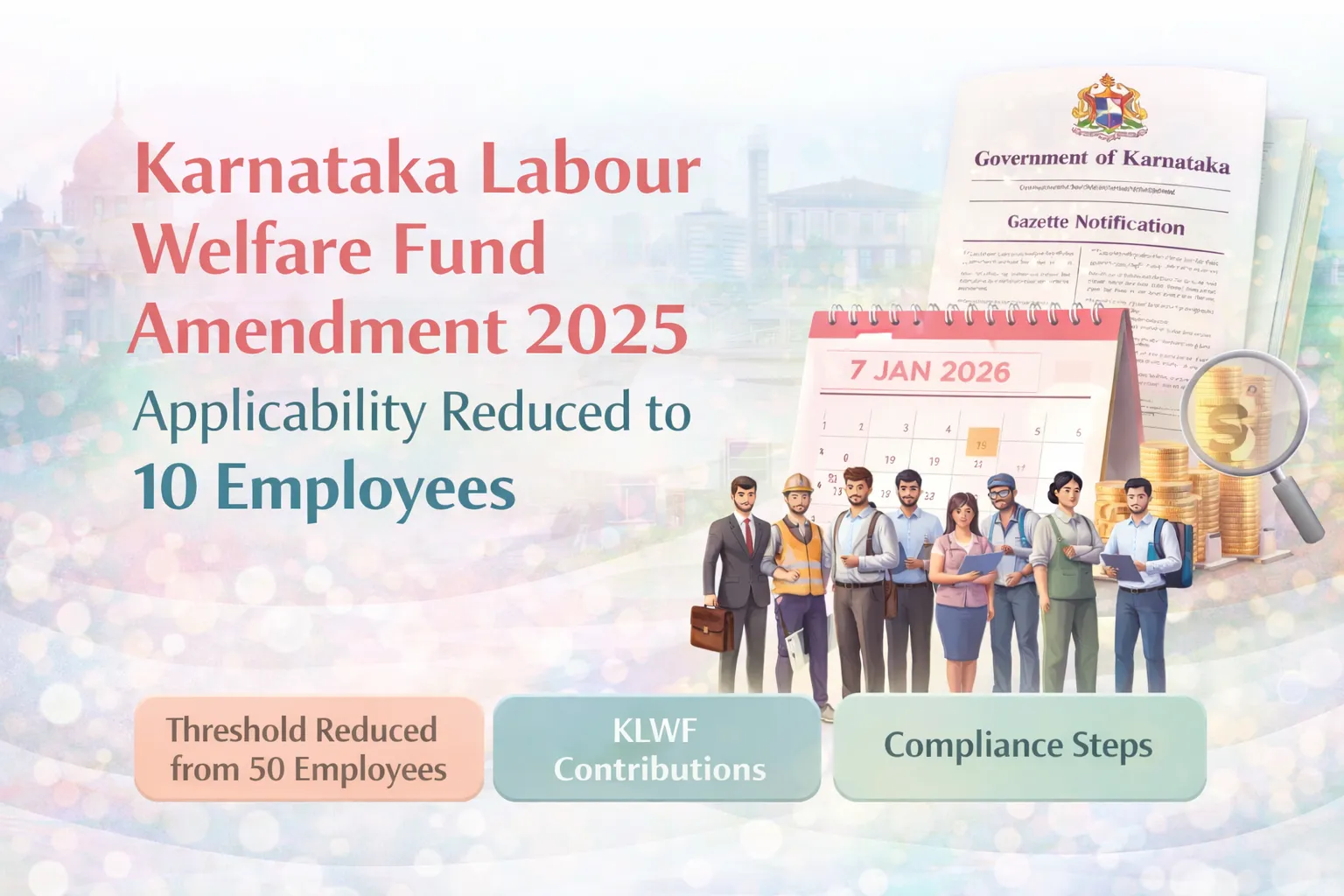
Applicability threshold reduced from 50 or more employees to 10 or more
The Karnataka Labour Welfare Fund (Amendment) Act, 2025 came into force on 7 January 2026. This is not a routine update; it is a decisive policy move that reshapes the compliance landscape by bringing a substantially larger base of establishments under the Labour Welfare Fund framework.
Immediate impact
More establishments now fall under KLWF. Small and mid-sized employers previously outside the framework may now need registration and ongoing compliance.
Core change
Applicability threshold reduced from 50 to 10 employees, expanding coverage across operational categories such as shops, establishments, and services.
Ease measure
Digital payment options are emphasised alongside legacy modes, reducing operational friction and improving process reliability.
Reduction in headcount threshold
From 50 employees to 10 employees: a structural expansion of coverage
The most important and immediate change is the reduction of the employee headcount threshold from 50 to 10. As a result, a far wider segment of smaller establishments may now be required to apply for registration and comply with the provisions of the Act, including contribution timelines and record readiness.
Why this matters operationally
Employers must re-check employee strength mapping, align payroll deductions, and ensure internal SOPs can handle compliance at scale without manual errors.
Contributions: current amounts (as stated)
The content notes that contributions were revised in 2024 and continue at present:
Employee contribution: ₹50 per year
Employer contribution: ₹100 per year
Total: ₹150 per year (per employee, as stated)
Employer contribution: ₹100 per year
Total: ₹150 per year (per employee, as stated)
This expansion requires payroll planning for a larger employee base and practical integration of deductions into payroll systems and controls.
Compliance experience upgrade
Digital payments and smoother compliance mechanisms
From an operational ease standpoint, the availability of online payment mechanisms—while retaining cheque and demand draft options—makes the process more workable for establishments newly entering the compliance net.
What smaller establishments must set up
Accurate employee tracking, payroll integration, digital payment workflows, and record/document management for audit and inspection readiness.
Policy direction in one line
The amendment reflects a policy shift to broaden employee welfare coverage while modernising compliance through digital governance and ease-of-doing-business objectives.
Long-run compliance payoff
Streamlined compliance, reduced manual intervention, and stronger alignment with broader digital governance systems.
Timeline and payment window
What employers should watch for: 2025 vs 2026 applicability
Effective date
The amendment is stated to be effective from 7 January 2026. This creates a practical question on whether coverage expansion applies to the year ended 2025 or to the calendar year 2026.
Interpretation risk (as discussed)
The narrative raises the possibility that the change may apply prospectively for calendar year 2026, retaining the old threshold for 2025 and transitioning into the new threshold for 2026.
Contribution period and due date (as stated)
Contributions are stated as payable each year between 1 January and 15 January. The last date of payment for calendar year 2025 is stated as 15 January 2026.
Delay consequence (as stated)
Interest at 12% per annum is stated to apply if delayed up to 3 months, with further consequences for delays beyond 3 months (as referenced in the content).
Coverage scope and welfare purpose
Broader coverage across operations, aligned to worker welfare objectives
The amendment is positioned to widen coverage across varied operations including factories, shops and establishments, plantations, workshops, transport undertakings, rental and leasing services, societies with staff, and charitable trusts with staff.
Welfare utilisation areas (as stated)
Education support, health facilities, housing support, recreation, financial assistance, holiday homes, reading rooms, and allied worker welfare activities.
Data points reported in the narrative (2024 references)
Welfare scheme utilisation
Of ₹251 crore over five years, ₹72 crore (28%) was stated as spent on welfare schemes.
Administrative expenses
Approximately 40% (slightly above ₹100 crore) was stated as spent on administrative expenses.
Collections and worker base
Annual accumulation of about ₹40 crore was stated, with projections that collections may rise to ₹105 crore post-hike. Organised worker base was stated at 4.9 million.
Scholarships
Scholarships for employees’ children are stated as a major spend area; ₹24.6 crore was stated as spent in 2023–24.
Note: The above figures are reproduced as provided in the content for contextual understanding. Validate the latest official statements/annual reports for current numbers.
Employer action plan
Key compliance steps for employers
Assess applicability based on current employee strength (10 or more employees).
Register under the Act with the Karnataka Labour Welfare Fund Authority, if not already registered.
Update payroll systems to reflect applicable employee and employer contributions.
Enable digital payment modes and align internal SOPs for payment execution and evidence retention.
Maintain contribution and employee records for audit and inspection readiness.
Communicate deductions transparently to employees through payslips or internal policy updates.
Align employee tracking and workforce data to avoid threshold misreporting or compliance gaps.
Prepare evidence-ready documentation for timely contribution, payment proof, and reconciliation.
Support
For compliance guidance and implementation support, write to marketing@karmamgmt.com