
Karma knowledge archive
Delhi Shops and Establishments (Amendment) Bill 2026: Key Labour Law Changes Employers Must Know
The Delhi Shops and Establishments (Amendment) Bill 2026 introduces major labour law changes including revised working hours, overtime limits, applicability thresholds, and night shift provisions for women employees. Learn the key compliance updates for employers in Delhi.
Original publication: 2026-03-16
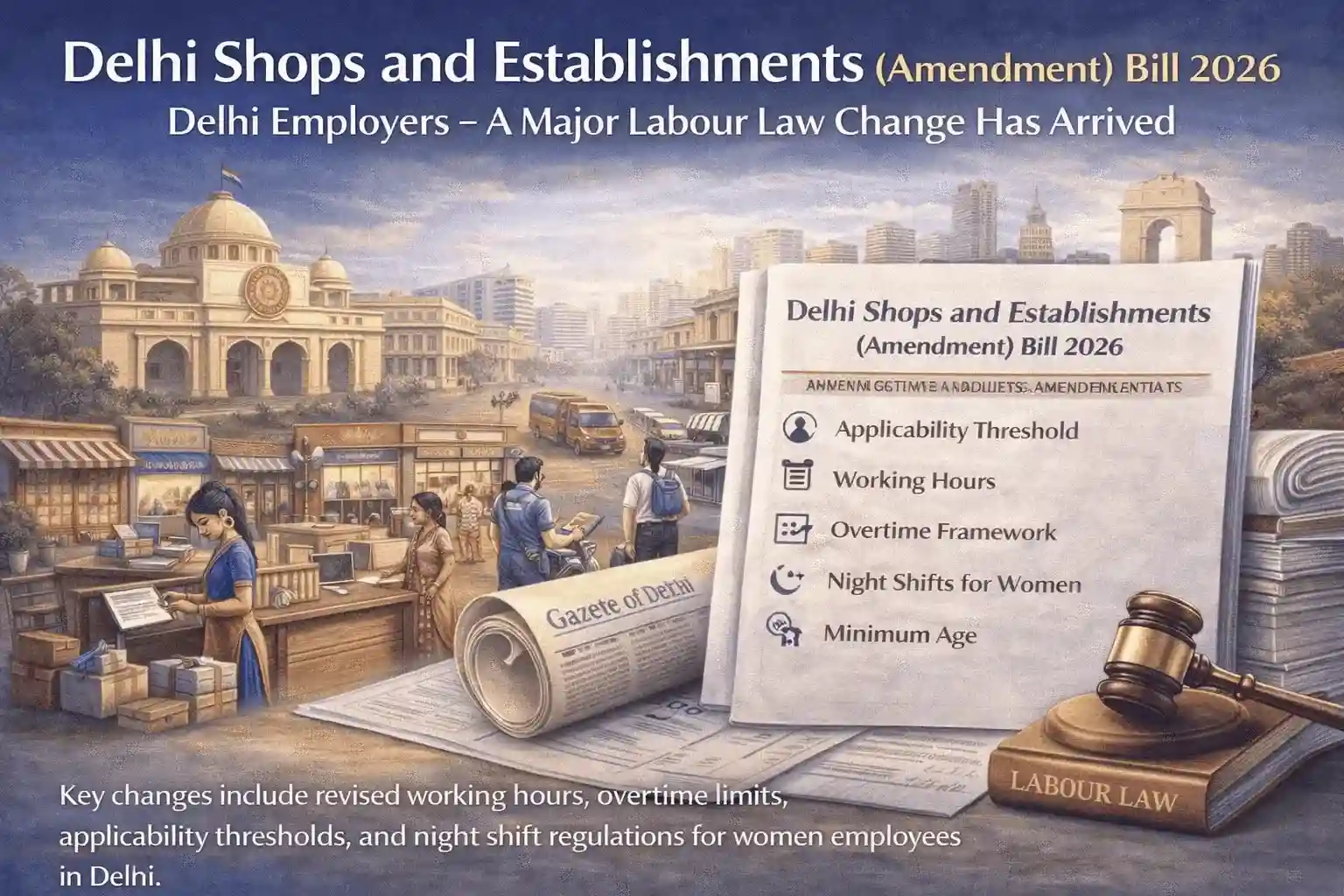
Delhi Shops and Establishments (Amendment) Bill, 2026
A Significant Labour Law Update for Employers in the National Capital Territory of Delhi
The Delhi Shops and Establishments (Amendment) Bill, 2026 represents an important development in labour law regulation within the National Capital Territory of Delhi. The Bill was introduced in the Delhi Legislative Assembly on 9 January 2026, followed by the release of the Gazette Notification on 11 March 2026.
This amendment updates the Delhi Shops and Establishments Act, 1954 to align with modern business requirements, labour reforms suggested by the Government of India, and evolving workforce dynamics.
The revised provisions address key aspects including working hours, overtime limits, applicability thresholds and women’s employment during night hours while attempting to maintain worker protection and support economic growth.
Establishments Covered Under the Act
The Act together with the 2026 amendments regulates working conditions for the following establishments:
Shops
Commercial establishments
Residential hotels
Restaurants
Theatres
Other notified establishments
Impact of the Amendment
Smaller establishments are excluded from the Act’s regulatory framework
Compliance burden on small businesses is reduced
Workers in smaller units may lose statutory protections under this Act
Five Critical Changes Employers Must Understand
Applicability Threshold
The Act now applies only to establishments employing 20 or more employees.
The Act now applies only to establishments employing 20 or more employees.
Increase in Working Hours
Maximum working hours have been revised to:
Maximum working hours have been revised to:
10 hours per day
60 hours per week
Overtime Framework Changed
Earlier limit: 150 hours per year
Revised limit: 144 hours per quarter
Earlier limit: 150 hours per year
Revised limit: 144 hours per quarter
Night Shift for Women Employees Permitted
Women may now work during night hours subject to safeguards including:
Women may now work during night hours subject to safeguards including:
Written consent
Transport arrangements
Security and CCTV surveillance
Compliance with the POSH Act
Rest Interval and Spread Over
Break required after 6 hours of work
Maximum spread over of working hours is 12 hours
Minimum Age for Employment – Section 2 Amendment
Minimum age for employment increased from 12 years to 14 years
This aligns with child labour welfare principles
Strengthens legal safeguards for minors
This amendment reflects a socially progressive approach and strengthens legal protection for young workers.
Why This Amendment Is Important
Businesses operating in retail, hospitality, offices, malls, restaurants and service establishments must review internal operational structures to align with the amended provisions.
Human resource policies
Shift structures and working hour planning
Overtime monitoring mechanisms
Safety compliance for women employees working night shifts
Overall Outlook
The Delhi Shops and Establishments (Amendment) Bill, 2026 reflects a modernized regulatory approach aimed at supporting business activity while ensuring essential worker safeguards.
The framework is business responsive in structure
Provides flexibility in working hours regulation
Encourages progressive participation of women in the workforce
Aligns gradually with broader labour code reforms
While the amendment promotes economic activity across sectors in the National Capital Territory, the expansion of working hour flexibility makes compliance monitoring and internal governance critical for organizations.
Conclusion
The amendment fundamentally reshapes labour compliance requirements in Delhi. Employers, HR professionals, chartered accountants, legal practitioners and students of labour law must update their understanding of the revised provisions.
Failure to align organizational policies with the amended law may expose employers to regulatory risks and potential labour law violations.
For more assistance and professional guidance, you may write to marketing@karmamgmt.com