
Karma knowledge archive
ESI Overtime Rules 2026 – Employee Benefits for Injury During Overtime Explained
Understand ESI benefits during overtime work in India. Learn how medical and disablement benefits apply even when overtime wages are excluded from contributions under labour laws.
Original publication: 2026-04-13
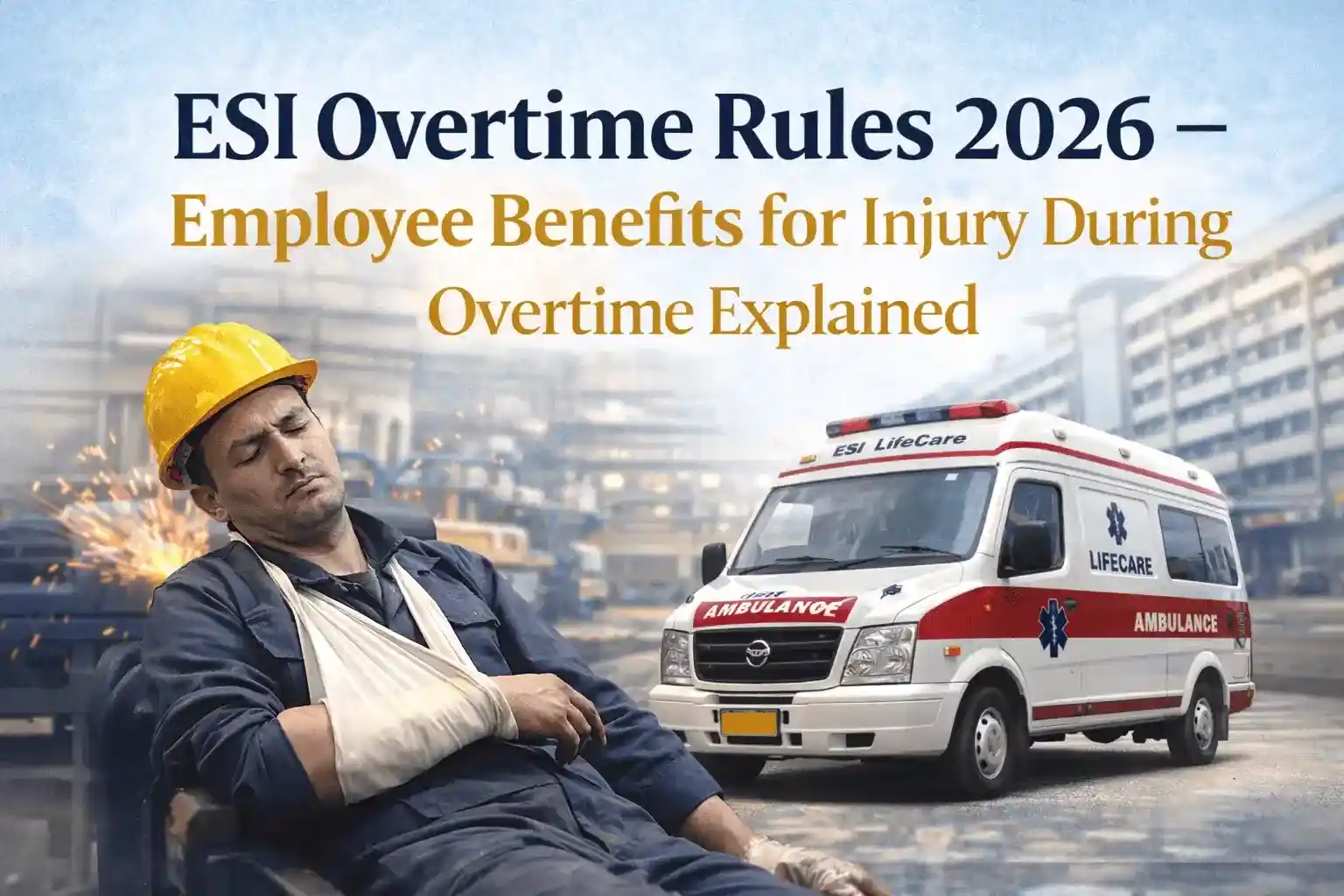
ESI Overtime and Entitlement to Medical and Disablement Benefits in Case of Employment Injury
A key concern under the labour law framework is whether employees are entitled to ESI benefits if an injury occurs during overtime work. Despite overtime wages being excluded from contribution calculations, entitlement to benefits is governed by statutory conditions rather than wage components.
Legal Position on ESI Benefits
Entitlement to ESI benefits depends on whether the individual qualifies as an employee under the Code on Social Security, 2020 and whether the injury qualifies as an employment injury arising out of and in the course of employment.
If an accident occurs during overtime that is assigned, permitted or incidental to employment, it satisfies the condition of employment injury and qualifies for ESI benefits.
Contribution vs Benefit Eligibility
Although overtime wages are excluded from wage calculations for contribution under labour laws, this does not affect benefit eligibility.
ESI benefits are not dependent on contributions paid on each wage component. Coverage is based on employee eligibility, wage ceiling limits and establishment coverage.
Disablement benefits are linked directly to the occurrence of an employment injury and not to the inclusion of overtime wages in contribution calculations.
Why Overtime is Excluded for Wage Ceiling
Overtime payments are not regular and are considered occasional in nature. Including overtime in wage ceiling calculations may lead to fluctuation in employee coverage under the ESI scheme.
Therefore, overtime is excluded from wage limits for coverage stability, while still being considered for contribution in certain contexts to cover risks during overtime work and enable enhanced benefit calculations.
ESI Benefits in Case of Overtime Injury
An injury sustained during overtime work qualifies as an employment injury if it arises out of and in the course of employment.
Employees are entitled to Temporary Disablement Benefit at 90 percent of wages from day one for the duration of disability.
In cases of permanent disability, employees receive a monthly pension based on loss of earning capacity as assessed by the medical board.
Full medical care is provided throughout the period of incapacity, ensuring comprehensive support to the employee.
Conclusion
Even if ESI contributions are not payable on overtime wages, employees remain entitled to medical and disablement benefits if an injury occurs during overtime work, subject to statutory eligibility conditions.
This ensures that employee protection remains intact regardless of wage component classifications under labour laws.
For Professional Advisory Support
Connect with Karma Management for guidance on payroll, labour law compliance, ESI regulations, staffing and governance frameworks tailored for your organisation.
Write to: marketing@karmamgmt.com