
Karma knowledge archive
General Elections 2026: Paid Holiday Rules for Employees and Employer Compliance in India
Know the paid holiday rules for employees during General Elections 2026 in India. Understand employer obligations under the Representation of the People Act, 1951, state practices, exemptions and compliance requirements.
Original publication: 2026-03-23
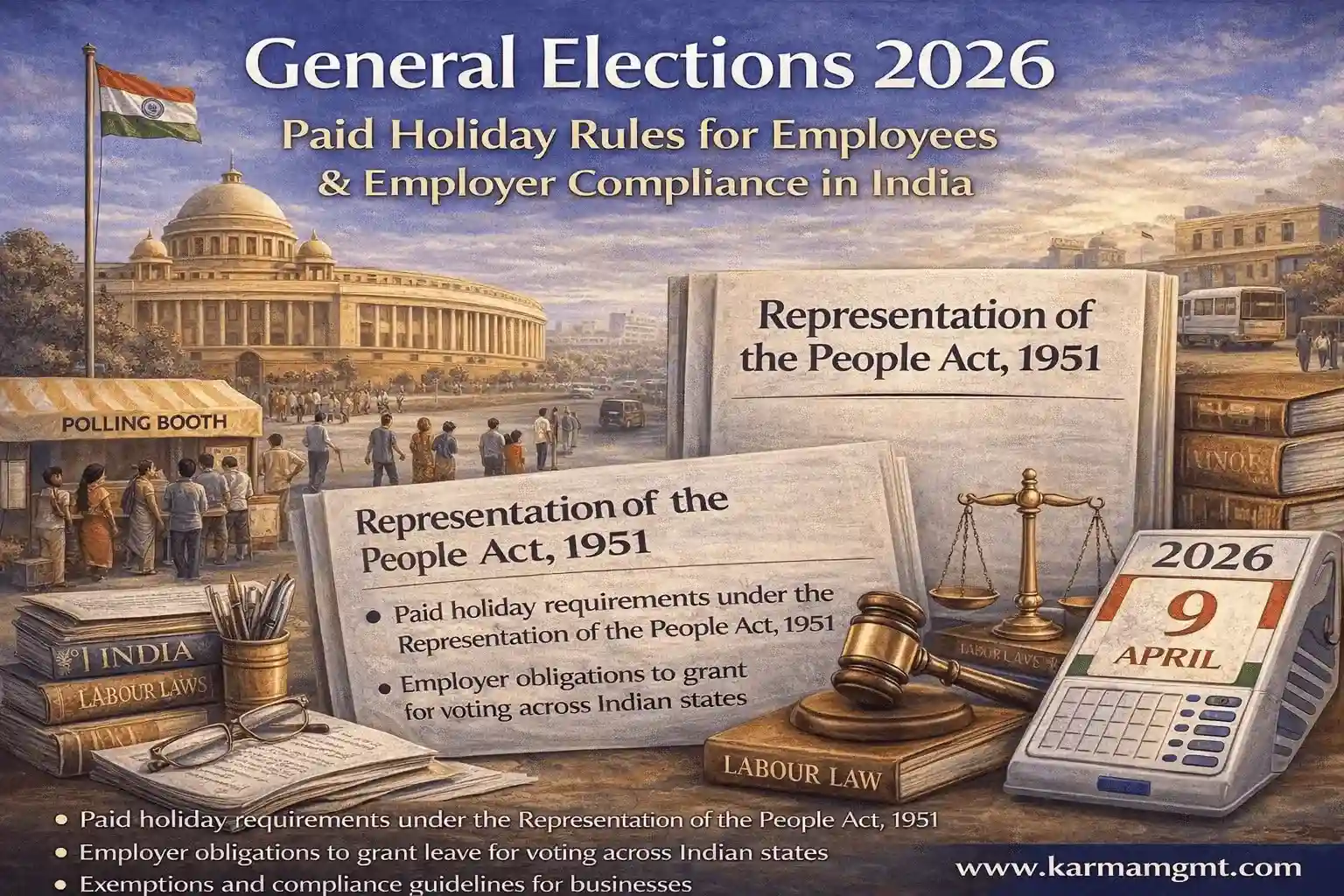
General Elections 2026: Paid Holiday Rules and Employer Compliance in India
The Election Commission of India, through its notification dated 16th March 2026, has announced General Elections to Legislative Assemblies in Assam, Kerala, Tamil Nadu, West Bengal and the Union Territory of Puducherry, with polling scheduled across April 2026.
Polling Schedule Overview
Polling in Assam, Kerala and Puducherry will be held on 9th April 2026. Tamil Nadu will go to polls on 23rd April 2026, while West Bengal will conduct polling in phases on 23rd April and 29th April 2026.
These elections trigger statutory obligations for employers regarding paid leave for employees to exercise their voting rights.
Paid Holiday on Voting Day
Under Section 135B of the Representation of the People Act, 1951, employers are required to provide paid holiday or reasonable time-off to employees to cast their vote.
This provision ensures that no employee is deprived of participating in the democratic process due to work obligations.
State-Level Practices and Notifications
Various states have historically issued specific notifications granting paid leave on polling days. Kerala announced paid holidays for private sector employees during its Local Body Elections in December 2025.
Telangana declared a paid holiday under the Negotiable Instruments Act for polling in select constituencies, while Maharashtra granted leave or working hour relaxation for municipal elections to ensure voter participation.
Himachal Pradesh and other states have similarly invoked statutory provisions to mandate paid leave for elections.
Legal Framework Across Acts
Apart from the Representation of the People Act, provisions also exist under the National and Festival Holidays Acts of various states such as Karnataka and Odisha, mandating a full-day holiday on polling day.
The Shops and Establishments Acts in states like Punjab, Haryana and Chandigarh empower authorities to declare polling days as closed days for establishments.
Exemptions and Employer Flexibility
Certain industries may seek exemptions where employee absence could lead to operational risk or substantial loss, subject to prior approval from authorities.
Employers can adopt flexible arrangements such as work-from-home or adjusted working hours to ensure employees can vote without disrupting business continuity.
Judicial Interpretation
The Madras High Court has clarified that holidays declared under the Negotiable Instruments Act do not automatically apply to private establishments governed by the Factories Act, 1948.
Employees in such establishments may not be entitled to wages if they fail to report to work unless specific provisions apply.
Conclusion and Employer Responsibility
Section 135B of the Representation of the People Act, 1951 remains the primary binding provision requiring employers to grant paid leave or adequate time-off for voting. Employers must ensure compliance while balancing operational needs through structured planning.
For assistance, write to: marketing@karmamgmt.com
Karma Management Global ensures complete labour law compliance, payroll processing, staffing and governance solutions, enabling your business to operate seamlessly while meeting all statutory obligations.