Karma knowledge archive
ESIC Compliance & Services for Educational and Medical Institutions
ESIC compliance services, ESIC for educational institutions, ESIC for hospitals, ESI Act 1948 compliance, ESIC registration support, payroll and ESIC alignment, social security code ESIC, statutory compliance India, Karma Global ESIC services
Original publication: 2026-02-09
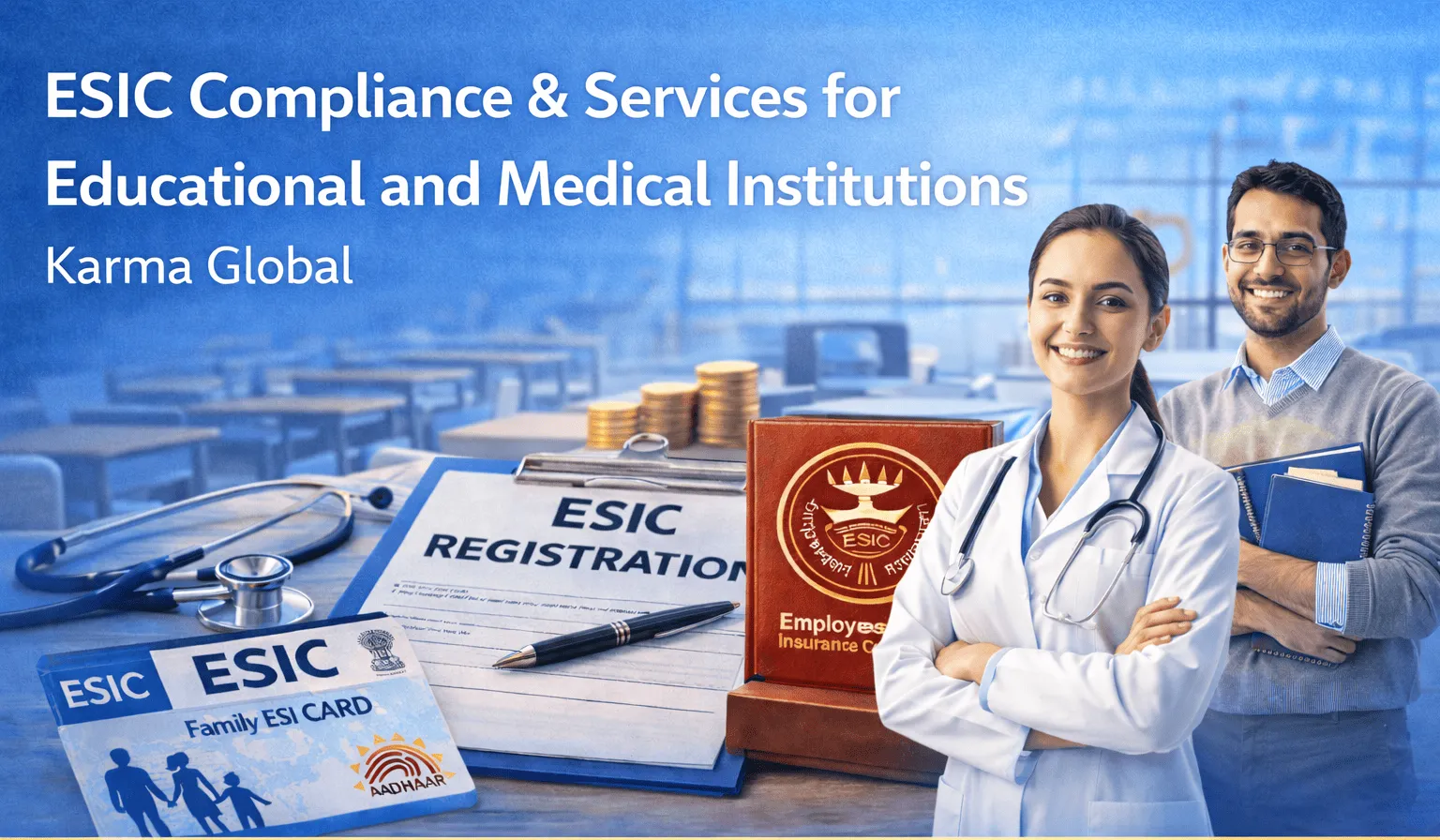
ESIC + Social Security Code: New-Sector Readiness
With social security coverage expanding into newer sectors and institutions, ESIC compliance is moving from “optional awareness” to “operational necessity”. This note explains the ESIC context and how Karma Global can take end-to-end ownership for educational and medical institutions and other eligible establishments.
Quick Contact
marketing@karmamgmt.com
For onboarding, documentation, payroll alignment, audits and training.
Background about ESIC
The Employees' State Insurance Corporation (ESIC) is established under the Employee's State Insurance Act, 1948 to safeguard the welfare of eligible workers. Covered establishments must register and ensure contributions and filings so employees can access social insurance benefits designed to provide support during illness, maternity, disability, and in the event of a member’s demise.
Compliance is essential. Non-compliance can trigger penalties and legal action. For covered employers, ESIC compliance is both a statutory duty and a workforce wellbeing obligation.
Why this matters now
Government focus on structured social security coverage has increased. For institutions and establishments that were historically outside the practical ESIC compliance ecosystem, the shift calls for immediate readiness: registrations, payroll mapping, documentation hygiene, and employee onboarding.
In a rapidly evolving regulatory landscape, labour law compliance is not only a legal requirement but also a cornerstone of sustainable growth, transparency, and employee trust.
ESIC services on your lap for educational and medical institutions
Leveraging our expertise: what you need and how we start
Obtain ESIC Code Number for your establishment
Register eligible on-roll employees on the ESIC portal
Align ESIC records with payroll data
Support documentation and statutory declarations
Ensure smooth implementation with minimal disruption
In what way does this help
The Government has made it compulsory for eligible establishments and institutions to be covered under the ESI Scheme where the Act applies. For organizations, this means:
Stronger employee welfare access, lower compliance risk exposure, clearer payroll governance, and better readiness under the evolving labour-code framework.
ESIC compliance becomes a structured operational system rather than an ad-hoc filing activity.
How Karma Global delivers ESIC compliance across India
1. Applicability assessment
Assess applicability of the Codes and the ESI Act based on your organization’s size, industry, and location.
2. Salary structure review
Evaluate how wage definitions impact payroll components such as basic wages, DA, allowances, bonus, gratuity and leave elements.
3. Documentation readiness
Ensure employee records, payroll data and compliance filing documentation meet updated requirements.
4. State-specific tracking
Monitor state-level amendments and ESIC operational realities so benefits are accessible and compliance stays aligned.
5. Policy updates
Review HR policies, employment contracts, wage structures and leave entitlements for ESIC alignment.
6. Regulatory guidance
Practical interpretation support, including multi-location, multi-state compliance execution via experienced teams.
7. Audit and compliance checks
Regular audits to reduce penalties and strengthen inspection readiness for payroll, benefits, and compliance practices.
8. Training and awareness
Workshops for teams and employees to build awareness of rights and responsibilities under social security obligations.
9. Dispute support
Assistance in resolving concerns and grievances efficiently through structured guidance and escalation support.
10. Expert-led execution
Work with law and compliance professionals for accurate interpretation and seamless implementation.
Why educational and medical institutions choose Karma Global
Clear focus on on-roll ESIC compliance
Structured implementation with clean payroll and documentation alignment.
Sector-specific understanding
Practical understanding of operating realities in schools, colleges, hospitals and clinics.
Single point of contact ownership
Reduced coordination load through accountable ownership and structured timelines.
Lower risk, better employee experience
Improved compliance stability while ensuring eligible employees can access benefits.
Background about Karma Global
For over 21+ years, Karma Global has been at the forefront of empowering global success as a leading provider of innovative Global Tech Consultants, serving clients worldwide. Our commitment to adaptability and market responsiveness enables us to harness AI-ML and RPA, unleash on-demand talent, and set new industry benchmarks.
Rooted in our heritage and preserving a strong foundation, our journey of evolution is driven by the brilliance of our people and propelled by technology. We continuously envision the future of the industry and the success of our clients.
The benefits of compliance
Aligning with social security obligations reduces legal risk, strengthens employee trust, improves employer-employee relations, and supports a more productive workforce. Organisations that prioritise compliance are better positioned to attract and retain talent.
Talk to Karma Global
Payroll, statutory compliance (PF, ESI, PT, LWF), outsourcing, labour laws, staffing, training, and governance frameworks tailored for MSMEs.
Write to: marketing@karmamgmt.com
Note: This content is shared for general awareness and may require context-specific validation based on establishment type, wage structure and notified applicability.