
Karma knowledge archive
ESI Act Extension to Educational & Medical Institutions in Maharashtra
Maharashtra has extended the ESI Act, 1948 to educational and medical institutions with 10+ employees. Understand applicability, who is covered up to ₹21,000 wages, key benefits, contribution rates, and compliance steps.
Original publication: 2026-02-09
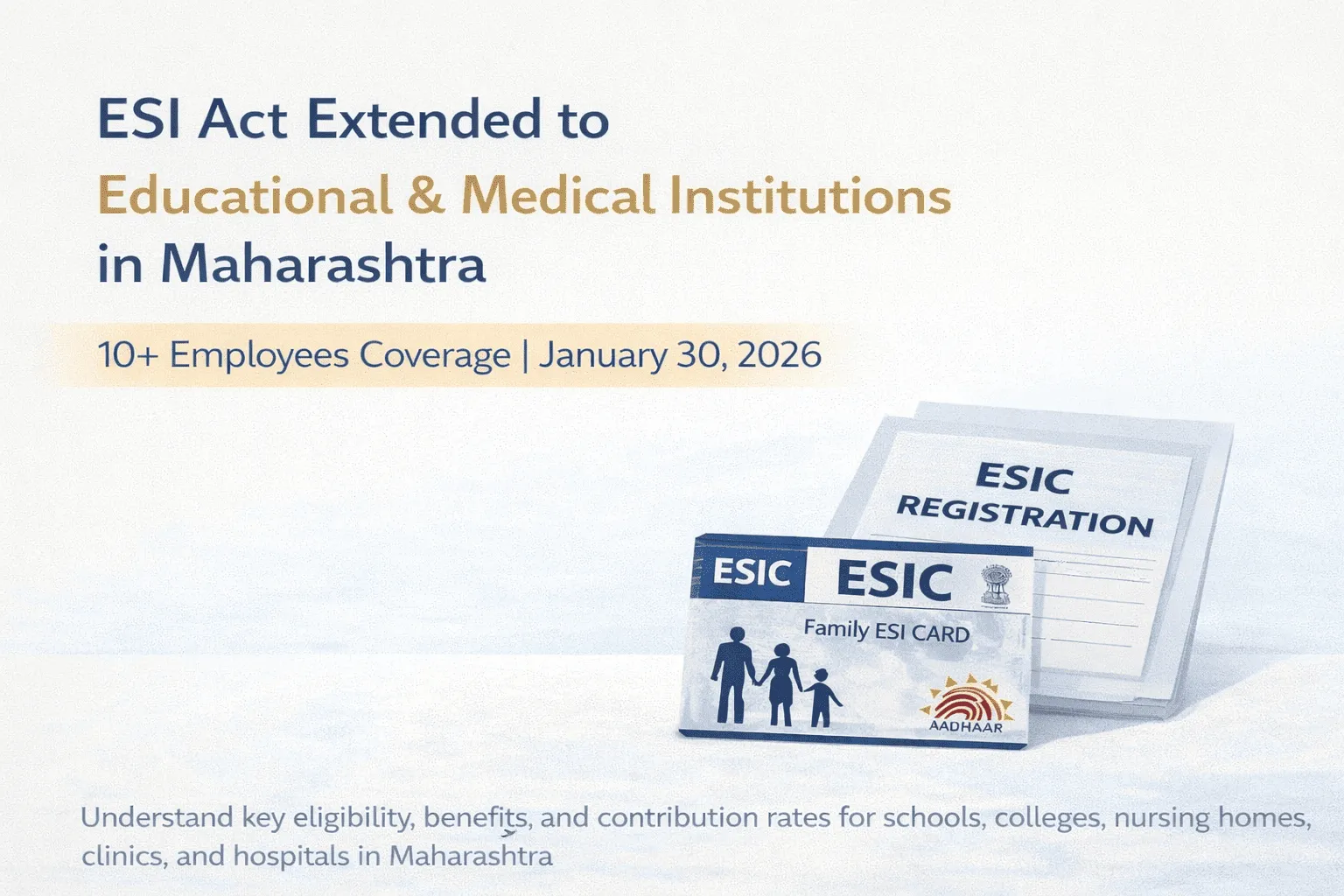
ESIC | Educational and Medical Institutions
A structured note on how the Employees’ State Insurance Act, 1948 applies to educational and medical institutions, with a focus on Maharashtra’s notification dated 30 January 2026.
Key highlights
Coverage thresholds can be 10+ for factories and, in several States, 10+ for establishments under Section 1(5). Wage eligibility generally applies up to ₹21,000 per month (₹25,000 per month for Persons with Disability). Eligible institutions must register and align payroll and compliance processes accordingly.
Background
The Employees’ State Insurance Act, 1948 is a social security legislation that provides medical care and cash benefit in the contingencies of sickness, maternity, disablement and death due to employment injury to workers.
The threshold for coverage of factories is 10 or more persons and some State Governments have reduced the threshold limit of coverage of establishments from 20 to 10 persons or more under Section 1(5) of the ESI Act.
The scheme was extended in 2024 to new sectors of employment, including educational institutions, private medical institutions and contract and casual employees of Municipal Corporation or Municipal Bodies.
As on 01.01.2024, 30 States/UTs notified educational institutions and 29 States/UTs notified medical institutions. Some States had not yet notified applicability at the 10+ threshold for educational and medical institutions, and Maharashtra was one of them.
Applicability and to whom
The Public Department of the Government of Maharashtra issued a notification on 30 January 2026 extending the ESI Act, 1948 to educational and medical institutions with 10 or more employees in the preceding 12 months. Employees drawing wages up to ₹21,000 per month (₹25,000 per month for Persons with Disability) are covered under the Act.
All categories and classes of employees are covered irrespective of title, designation, hierarchy, qualification or status, as long as wages are within the threshold.
Teaching and non-teaching staff in educational institutions, and nurses, technicians, administrative staff, support staff and employed doctors in medical institutions are covered.
Contract staff working on the premises may be covered as employees as applicable. External consultants and third-party vendors are not covered as employees under the institution.
The Social Security Code framework extends the ESI scheme to new sectors, including gig and platform workers who were not covered under previous legislation.
Registration with ESIC is mandatory for establishments meeting the criteria, including educational and medical institutions that were previously excluded in many cases.
Voluntary inclusion
Establishments with fewer than 10 employees may opt for coverage under the ESI scheme if the employer and the majority of employees agree, subject to applicable rules and approvals.
If you already have a private medical scheme or free hospitalisation
Institutions often ask why ESIC is needed if a private medical scheme already exists or if a hospital provides free medical benefits. ESIC remains applicable when eligibility conditions are met.
The scheme provides a safety net against financial distress due to sickness, disablement or death caused by employment injuries and offers a broad range of statutory benefits, including medical care, sickness benefits, maternity benefits, disablement benefits and unemployment allowance (as applicable).
Why ESIC is significant for schools
This ensures staff continuity during the academic year and reduces unexpected financial liabilities for the institution.
How ESIC helps schools with maternity costs
Maternity wages are paid by ESIC, not the school
26 weeks of paid maternity leave is covered
This significantly reduces the financial burden on schools employing women staff
How ESIC benefits healthcare staff
ESIC is particularly valuable for staff exposed to higher occupational risks and intensive work conditions.
The scheme supports medical treatment, income replacement and disablement-linked benefits as applicable.
How ESIC reduces hospital employer risk
ESIC shifts defined liabilities from the employer to a government-administered insurance framework for eligible employees.
Medical treatment (as applicable)
Injury compensation exposure
Disablement-related benefits
Death benefits to dependants in eligible cases
ESIC contribution rates
Contribution rates reduced with effect from 01/07/2019.
Need support for ESIC readiness and implementation?
Talk to Karma Global about payroll, statutory compliance (PF, ESI, PT, LWF), outsourcing, labour laws, staffing, training and governance frameworks tailored for MSMEs.
Write to: marketing@karmamgmt.com